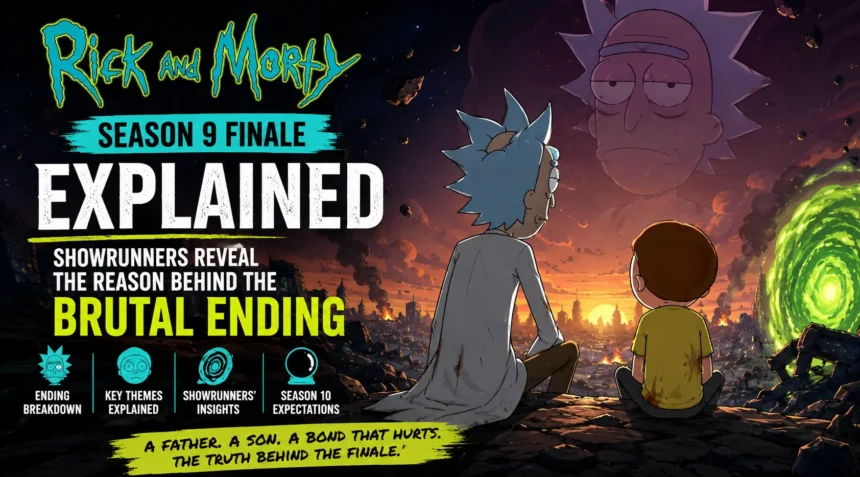
The finale does not end with a universe-destroying villain or a conventional cliffhanger. Instead, it places Morty inside the life he believes he wants—a loving Smith family and a gentler version of Rick—and shows how quickly that dream collapses. The Rick and Morty Season 9 Finale delivers a clear but painful answer: changing universes cannot remove the emotional damage Morty carries. His attempt to find a healthier family contributes to the destruction of another one, pushing him back toward Rick and reinforcing their unhealthy but deeply rooted bond. The creative team chose this outcome because Morty’s repeated exposure to emotionally impossible situations remains one of the show’s defining dramatic engines.
Quick Answer: What Does the Finale Mean?
“Field of Dreams” is about inherited damage, codependency, and the fear of becoming like the person who hurt you. Morty searches other dimensions for families mourning dead versions of him because he wants proof that his life matters. When one grieving Smith family welcomes him, he briefly experiences acceptance without the usual chaos. However, that family is already fragile. Morty’s arrival exposes unresolved grief, resentment, addiction, and estrangement. By the end, Morty accepts Rick as a father figure. The moment is warm on the surface but disturbing underneath: Morty may also be accepting that he cannot escape Rick’s influence.
Rick and Morty Season 9 Ending Explained: What Happens in “Field of Dreams”?
The episode opens around an estate sale connected to a dead Morty. Rick treats the event with detachment, while Morty is disturbed by how casually alternate versions of themselves move through another family’s tragedy. Morty begins visiting funerals held for dead Mortys across different realities. The montage is darkly comic, but its purpose is serious. He wants to discover whether anyone would genuinely mourn him. That search leads him to a Smith family whose Morty has died. They previously cut ties with Rick because of his alcoholism. Morty sees a chance to enter a home where he might be valued as a son and brother rather than treated as Rick’s adventure partner. For a short time, the arrangement works. Morty bonds with the alternate Jerry and receives the ordinary family attention he rarely experiences. Yet the household is not emotionally stable. Its members are using Morty to fill the absence left by their child, while Morty is using them to avoid confronting his real life. The Rick and Morty Season 9 episode ending becomes inevitable once those needs collide. Morty cannot replace the person they lost, and the family cannot become the clean emotional escape he imagined.
Why Rick and Morty Season 9 Ended That Way
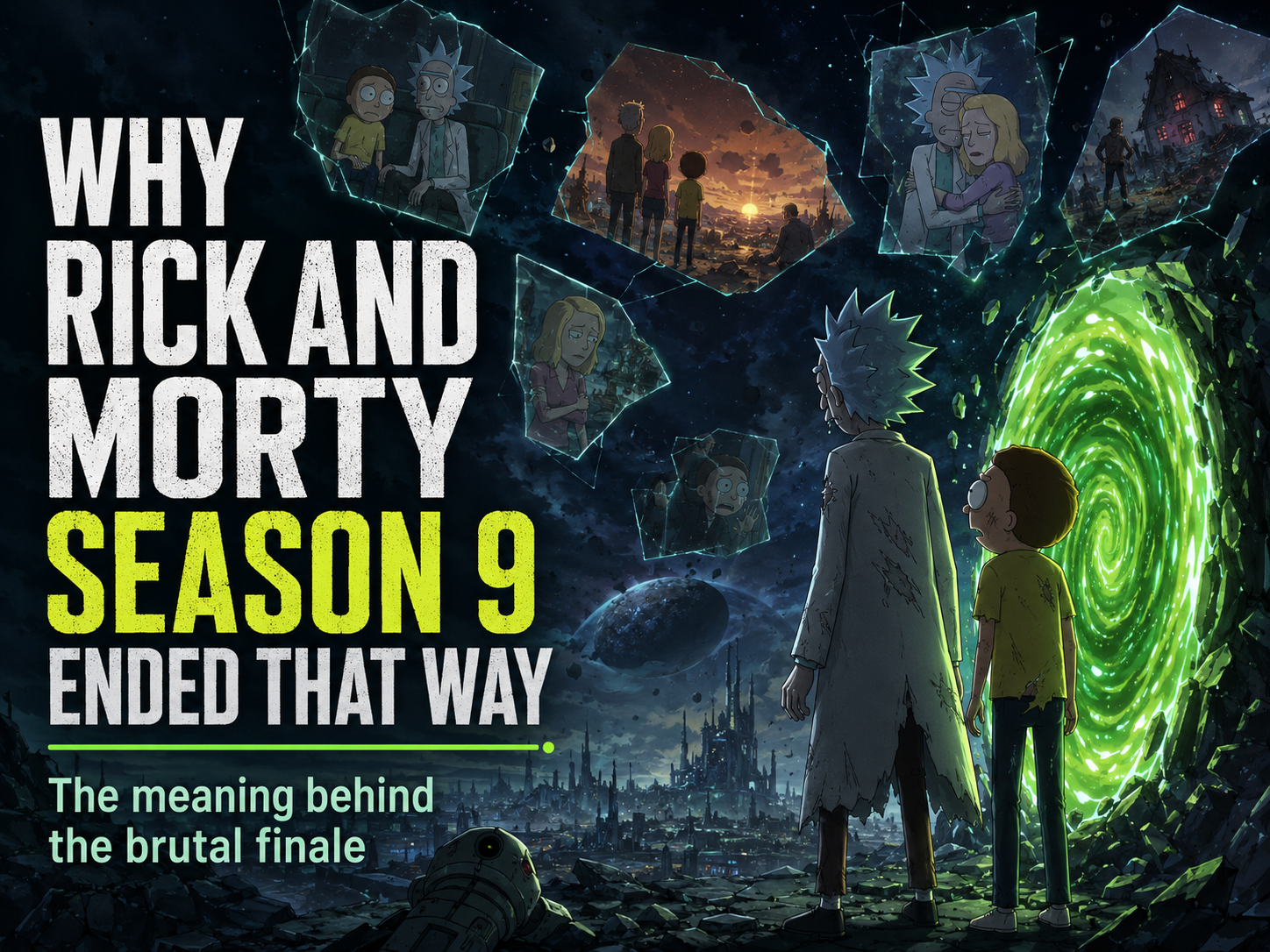
Dan Harmon explained that if the writers stopped putting Morty through these kinds of situations, there was concern that the series would become “unrecognizable.” That does not mean Morty can never grow. It means his growth must take place inside the central contradiction of the show: he becomes more capable and self-aware while remaining trapped in a relationship that repeatedly harms him. The Rick and Morty showrunners must protect a difficult balance. If Morty becomes completely independent, emotionally healthy, and unwilling to follow Rick, the familiar adventure structure breaks. If he never changes, however, the character becomes static and unconvincing. The finale allows Morty to understand more about himself without giving him an easy escape. That is the reason behind the Rick and Morty brutal finale. Morty gains insight, but insight alone does not heal him. He recognizes the pattern and still returns to it.
Professor Rick Shows the Life Rick Could Have Lived
The most revealing alternate character is Professor Rick, a sober and emotionally vulnerable version of Rick who has spent years attending recovery meetings. He became estranged from Beth after Diane disappeared, believing her loss was somehow connected to his failure. Morty understands the multiversal truth behind Diane’s disappearance and attempts to remove Professor Rick’s guilt. For a moment, Morty offers this version of Rick something his own grandfather rarely gives him: reassurance without ridicule. The scene reverses their usual roles. Morty becomes the informed and emotionally responsible person, while Rick becomes the frightened individual searching for answers. However, Morty also introduces information that destabilizes Professor Rick’s carefully constructed life. Professor Rick relapses, and the alternate family begins moving toward the same dysfunction Morty already knows. This development is central to the Rick and Morty ending analysis. Morty does not destroy the family because he is evil. He damages it because he arrives carrying knowledge, defenses, and emotional habits shaped by Rick. Morty wants to rescue people, but he learned how to perform a rescue from someone who regularly turns control into catastrophe.
What the Final Father-and-Son Scene Means
After the alternate family falls apart, Morty returns home. Rick takes him out at night on a motorcycle. Drunk and unusually exposed, Rick declares that he is effectively Morty’s father. Morty agrees. The moment supports two interpretations.
It Is an Acknowledgment of Love
Rick finally admits that Morty is more than a replaceable sidekick or convenient travel companion. Morty has become part of Rick’s identity. Rick’s declaration suggests that he recognizes a responsibility toward Morty, even if he remains incapable of expressing that responsibility in a healthy way.
It Is Also a Form of Surrender
Morty has just watched another Smith family collapse after he entered its life. He may now believe that he carries destruction with him, just as Rick does. Accepting Rick as his father could therefore mean accepting that their identities are becoming increasingly connected. The strongest interpretation combines both ideas. Their bond is genuine, but emotional reality does not automatically make the relationship healthy.
How the Finale Completes the Season’s Story
The Rick and Morty Season 9 plot repeatedly asks whether either lead can become happier without becoming a completely different person. Rick experiments with alternate lives, reduced intelligence, empathy, self-improvement, and different ways of managing his unhappiness. Morty faces Evil Morty’s judgment, Rick’s rejection, extreme empathy, family privilege, and the consequences of depending on technology he does not fully control. Within Rick Sanchez Season 9, Rick appears more self-aware but continues relying on alcohol, manipulation, intelligence, and emotional distance as protection. Within Morty Smith Season 9, Morty becomes more skilled and assertive. At the same time, he becomes increasingly isolated and psychologically similar to Rick. The finale connects those paths.
Rick fears vulnerability, while Morty fears insignificance. Their relationship temporarily answers both fears:
- Rick gets someone who continues to stay with him.
- Morty gets someone who depends on him.
- Both avoid confronting what a healthier separation might require.
- Their adventures continue, but so does the damage.
The same bond that gives them purpose may also prevent either character from changing fully.
Why Viewers Are Divided
The Rick and Morty Season 9 finale reaction has focused heavily on Morty’s emotional direction. Some viewers interpret the ending as honest affection between two deeply damaged characters. Others see Morty accepting toxic codependency as an unavoidable destiny. Both responses are supported because the scene is designed to feel comforting and alarming at the same time. The finale also avoids confusing scale with importance. It does not need a villain larger than Rick Prime or a device more dangerous than the Omega Device. Its threat is personal: Morty may be losing the ability to imagine an identity outside Rick’s orbit. That intimate approach makes the story feel more consequential than a conventional multiversal battle. The worst possible outcome is not simply that Morty dies. It is that Morty survives long enough to become emotionally indistinguishable from Rick.
What the Post-Credits Scene Suggests
The post-credits sequence follows Mrs. Poopybutthole and a scientific attempt to retrieve Mr. Poopybutthole through dimensional travel. The result remains uncertain, leaving room for either a successful return or another dangerous multiversal problem. It provides a lighter hook after an emotionally exhausting ending, but it also repeats the season’s warning: technology used to reverse loss rarely restores life exactly as it was. The experiment may become a future storyline, or it may function as another example of a character refusing to accept grief.
Rick and Morty Season 10 Expectations
Season 10 has already been secured, and Adult Swim has renewed the series through Season 12. The creative team has also indicated that upcoming episodes will offer varied storytelling, surprises, and recognition of the approaching 100th-episode milestone. (Likely areas of focus include:
- Morty becoming more independent while adopting more of Rick’s behavior.
- Rick confronting the increasingly parental nature of his bond with Morty.
- Consequences from the post-credits dimensional experiment.
- Returning characters such as Jessica or Dr. Wong.
- Further tests of whether emotional development can coexist with the show’s adventure format.
The official Adult Swim Rick and Morty hub confirms Season 9 availability, while readers following Rick and Morty latest news should separate confirmed information from fan theories. More seasons are confirmed, but the finale does not establish Morty as a future villain, a replacement for Rick, or another version of Evil Morty.
Frequently Asked Questions
1. Why was the Season 9 finale so dark?
The finale was dark because Morty’s search for love and stability proves that he carries Rick’s influence into every relationship. The outcome preserves the show’s central tension between emotional growth and destructive repetition.
2. Did Morty permanently leave his original family?
No. Morty briefly considers living with an alternate Smith family, but he returns to his original reality after the replacement arrangement collapses.
3. Does Morty become like Rick at the end?
Not completely, but the episode suggests Morty fears he is becoming like Rick. His competence, emotional isolation, and destructive impact make the comparison increasingly difficult to ignore.
4. What does Rick calling Morty his son mean?
It confirms that Rick has a genuine emotional attachment to Morty and views him as more than a sidekick. It also highlights their codependency because Morty accepts the bond immediately after failing to escape Rick’s influence.
5. Is Rick and Morty Season 10 officially happening?
Yes. The series is continuing beyond Season 9, and Adult Swim has renewed it through Season 12. A specific Season 10 premiere date was not confirmed in the sources reviewed for this article.
Conclusion
Beyond these Rick and Morty finale spoilers, the Rick and Morty Season 9 Finale succeeds because it refuses to offer a simple victory. Morty learns that another universe cannot give him a clean identity, while Rick reveals genuine affection without becoming emotionally safe. The ending is brutal because love and harm can exist within the same relationship. Morty returns not because everything has been fixed, but because Rick remains the person who understands the version of Morty that years of interdimensional trauma have created. The next season therefore faces a more meaningful question than “What villain comes next?” Can Morty remain close to Rick without becoming him, and can Rick love Morty without continuing to damage him?