Think about how often you interact with AI in a single day. You might ask a chatbot for help, receive personalized recommendations while shopping online, use voice commands on your smartphone, or rely on navigation apps that calculate the fastest route in seconds. A few years ago, many of these experiences felt futuristic. Today, they are simply part of everyday life.
If you’re searching for artificial intelligence news, you’re probably trying to understand where this fast-moving technology is headed. The pace of innovation is remarkable, with new breakthroughs, smarter tools, and fresh ideas appearing almost every week. Whether you’re a business owner, student, developer, or simply curious about technology, keeping up with AI developments can help you make smarter decisions in a world that’s becoming increasingly digital.
This guide takes a practical look at the biggest AI developments shaping 2026. Rather than focusing only on headlines, we’ll explore what these changes mean, why they matter, and how they could influence businesses and everyday users in the years ahead.
Why Artificial Intelligence Has Become So Important
Artificial intelligence has moved far beyond research labs and technology companies. Today, it supports countless industries and helps people solve real-world problems more efficiently.
Businesses are using AI to improve customer experiences, hospitals are adopting it to assist doctors with diagnosis, educators are creating personalized learning experiences, and manufacturers are making production lines smarter than ever before.
Some of the biggest advantages AI offers include:
- Automating repetitive daily tasks
- Processing massive amounts of information within seconds
- Supporting better business decisions through data analysis
- Strengthening cybersecurity systems
- Accelerating scientific research
- Improving productivity across teams
As adoption continues to grow, AI is also creating entirely new career opportunities while encouraging governments and organizations to develop responsible guidelines for its safe and ethical use.
AI News Today: What’s Driving the Industry?
The AI industry is evolving at an incredible speed. One of the biggest changes over the past few years is that businesses are no longer asking whether they should use AI. Instead, they’re asking how they can use it effectively without compromising security, privacy, or trust.
Several major developments are shaping today’s AI landscape.
Businesses Are Investing More Than Ever
Organizations of every size are increasing their investment in AI-powered tools. From startups to multinational corporations, companies are integrating AI into customer service, marketing, software development, finance, and operations.
Instead of replacing employees, AI is becoming a valuable assistant that helps teams complete routine work more efficiently.
Better Infrastructure Is Fueling Faster Growth
Powerful cloud platforms have made advanced AI systems more accessible than ever before.
Businesses no longer need to build expensive infrastructure from scratch. They can access sophisticated AI models through cloud services, allowing even smaller organizations to experiment with advanced capabilities.
This wider availability is helping accelerate innovation across multiple industries.
Responsible Development Is Becoming a Priority
As AI grows more capable, discussions around responsible development continue gaining momentum.
Technology companies, universities, policymakers, and researchers are working together to establish standards that improve transparency, reduce bias, protect user privacy, and encourage responsible AI deployment.
These efforts are helping create greater trust in AI-powered systems.
Latest AI News: Innovation Is Reaching Every Sector
Artificial intelligence is no longer limited to software companies. It has become an important tool across nearly every major industry.
Healthcare
Healthcare providers are using AI to support faster and more accurate diagnosis, analyze medical images, assist with treatment planning, and speed up pharmaceutical research.
Doctors remain at the center of patient care, while AI serves as a powerful decision-support tool that improves efficiency and accuracy.
Education
Educational institutions are embracing AI-powered learning platforms that adapt lessons to individual students.
Instead of delivering identical content to every learner, intelligent systems can recommend personalized study materials based on progress, strengths, and learning speed.
Teachers also benefit from automated grading, lesson planning assistance, and administrative support, giving them more time to focus on students.
Finance
Banks and financial institutions increasingly depend on AI for:
- Fraud detection
- Credit risk analysis
- Investment research
- Customer support
- Financial forecasting
These technologies help organizations process information faster while improving customer experiences and strengthening security.
Artificial Intelligence Updates Transforming Businesses
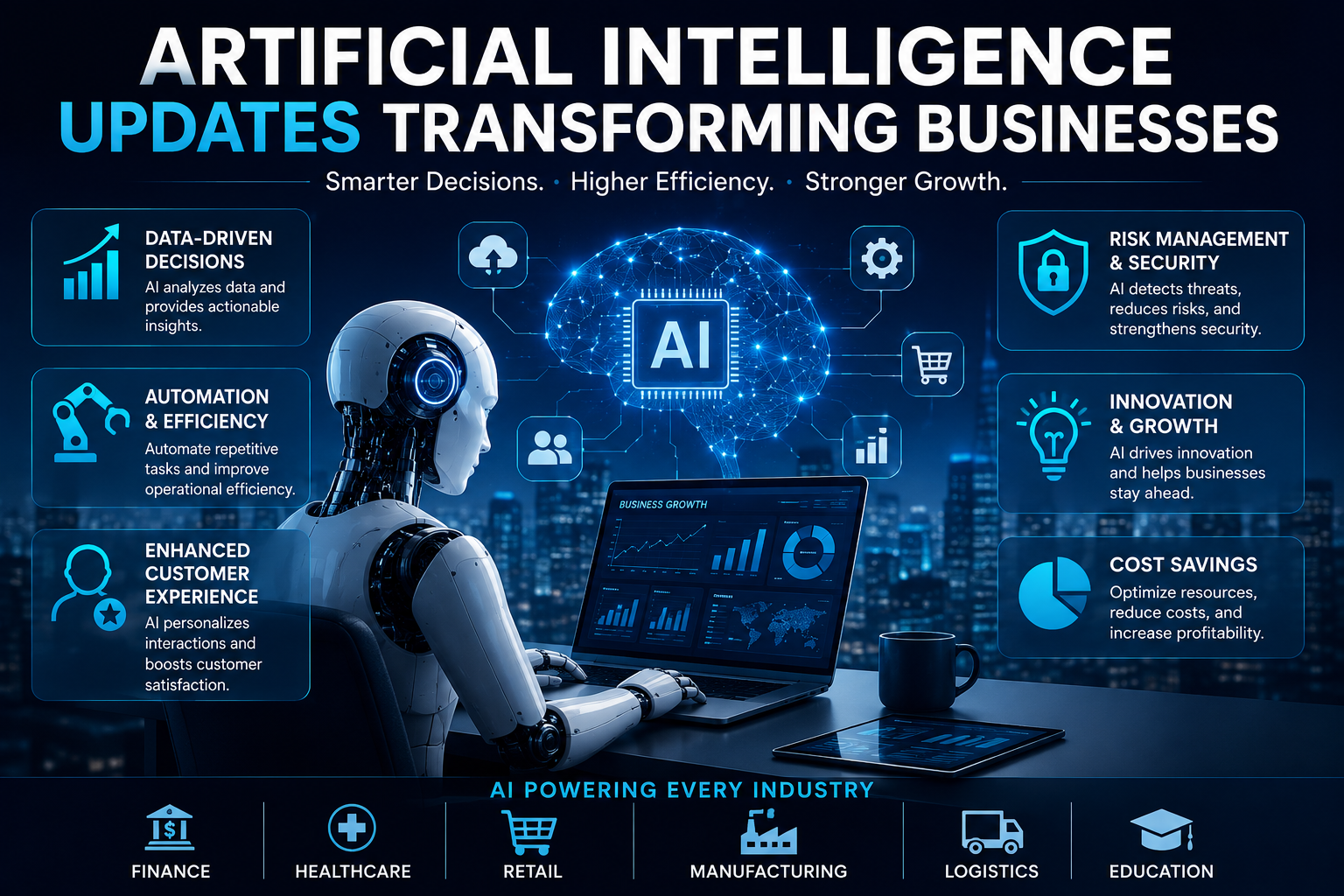
For many organizations, AI has shifted from being an experimental technology to becoming an essential business strategy.
Companies are discovering that intelligent automation can improve efficiency without sacrificing quality.
Smarter Customer Service
Modern AI assistants can answer common customer questions instantly, provide personalized recommendations, support multiple languages, and remain available around the clock.
This allows human support teams to dedicate more time to handling complex or sensitive customer issues.
Better Business Decisions Through Data
Every business generates enormous amounts of information each day. The challenge isn’t collecting data—it’s making sense of it.
AI helps organizations identify hidden patterns, forecast future demand, detect emerging trends, and support strategic planning using real-time insights.
Rather than relying on guesswork, business leaders can make more informed decisions backed by meaningful data.
Increased Workplace Productivity
One of AI’s biggest strengths is reducing repetitive work.
Employees now use AI to help with scheduling meetings, organizing documents, summarizing reports, managing emails, and automating routine workflows.
Instead of spending hours on administrative tasks, professionals can focus on creative thinking, innovation, and problem-solving.
The Rise of Generative AI
Among the most exciting developments in recent years is generative AI, a technology capable of creating original content instead of simply analyzing existing information.
Today, AI systems can produce:
- Written articles
- Images
- Videos
- Computer code
- Business presentations
- Marketing content
- Creative ideas
This has transformed how creators, designers, marketers, developers, and businesses approach their daily work.
Even so, human creativity and judgment remain essential. AI can generate ideas quickly, but people still play a critical role in verifying accuracy, maintaining originality, and ensuring content meets quality standards.
How AI Technology Is Becoming Easier to Use
Not long ago, advanced AI systems were available mainly to large technology companies with significant computing resources.
That picture has changed dramatically.
Today, AI technology is accessible to startups, freelancers, educators, researchers, nonprofit organizations, and small businesses through cloud-based platforms and easy-to-use applications.
Low-code and no-code AI tools are making intelligent automation available to people with little or no programming experience.
As access continues to improve, more individuals and organizations can experiment with AI, develop innovative solutions, and compete on a level that was once reserved for the world’s largest technology companies.
AI Trends 2026: What’s Shaping the Future?
Artificial intelligence isn’t standing still. Every month brings new ideas, smarter systems, and better ways to solve everyday problems. In 2026, the biggest trend isn’t just creating more powerful AI models—it’s making them more practical, reliable, and easier for people to use.
Businesses are moving beyond small AI experiments and integrating intelligent systems into their long-term strategies. The goal is simple: improve productivity, make better decisions, and create better experiences for customers.
Let’s look at the trends making the biggest impact this year.
AI Agents Are Becoming Everyday Work Partners
One of the most exciting developments is the rise of AI agents. Unlike traditional chatbots that answer one question at a time, AI agents can handle complete workflows from start to finish.
They can:
- Organize projects
- Plan schedules
- Conduct online research
- Prepare reports
- Respond to customer inquiries
- Help teams manage daily operations
Instead of replacing employees, these assistants are helping people work faster and spend more time on creative and strategic tasks.
Multimodal AI Is Making Technology More Natural
AI systems are becoming much better at understanding different types of information at the same time.
Instead of working only with text, modern models can process:
- Images
- Audio
- Videos
- Documents
- Charts
- Written content
This makes communication between humans and computers feel much more natural. Whether someone uploads a photo, speaks a question, or shares a document, AI can understand the context more effectively than ever before.
Smaller Models Are Making AI More Practical
While large AI systems often make headlines, many businesses are discovering the value of smaller, specialized models.
These compact systems require fewer computing resources, respond more quickly, and are often easier to deploy within existing business environments.
For organizations focused on speed, privacy, and affordability, smaller AI models are becoming an attractive solution.
Machine Learning Continues to Power Modern AI
Although artificial intelligence receives most of the attention, machine learning remains the engine behind many of today’s smartest technologies.
Instead of relying on fixed instructions, machine learning allows computers to identify patterns in data and improve their performance over time.
You already interact with machine learning every day without even realizing it.
It powers:
- Movie recommendations
- Online shopping suggestions
- Spam email filtering
- Fraud detection
- Navigation apps
- Voice assistants
As businesses collect better data, machine learning systems continue becoming more accurate, reliable, and useful.
Learning Never Stops
One reason machine learning has become so valuable is its ability to improve continuously.
Rather than remaining static like traditional software, AI systems can adapt as new information becomes available.
For businesses, this means better forecasts, more accurate predictions, and smarter decision-making over time.
AI Innovations Are Transforming Every Industry
Some of the biggest AI innovations are happening outside the technology sector. Organizations across the world are finding creative ways to solve real business challenges with intelligent systems.
Here are a few industries leading the way.
Healthcare
Healthcare professionals now use AI to support earlier disease detection, analyze medical scans, and assist with treatment planning.
Researchers are also using intelligent systems to speed up drug discovery, helping reduce the time required to develop potential medicines.
Instead of replacing doctors, AI gives them better information to support patient care.
Manufacturing
Manufacturing companies are using AI to create smarter factories.
Intelligent systems help teams:
- Monitor equipment performance
- Predict maintenance needs
- Improve product quality
- Reduce downtime
- Optimize production schedules
These improvements save time while reducing operational costs.
Retail
Retail businesses continue finding new ways to improve shopping experiences through AI.
Common applications include:
- Personalized product recommendations
- Inventory management
- Demand forecasting
- Customer support
- Supply chain optimization
Customers enjoy more relevant shopping experiences, while businesses gain better insights into consumer behavior.
Transportation
Transportation companies are using AI to improve both efficiency and safety.
Examples include:
- Route planning
- Traffic forecasting
- Fleet optimization
- Delivery scheduling
- Autonomous driving research
These solutions help reduce fuel consumption, shorten delivery times, and improve overall logistics performance.
Why Responsible AI Matters
As AI becomes more powerful, responsible development is becoming just as important as innovation itself.
Businesses and technology companies understand that users must be able to trust the systems they interact with every day.
Responsible AI focuses on several important principles:
- Fairness
- Transparency
- Privacy
- Security
- Accountability
Building trustworthy AI isn’t only good ethics—it also creates stronger customer confidence and supports long-term success.
Questions the Industry Is Still Solving
Despite impressive progress, several important discussions continue around the world.
These include:
- How should AI-generated content be identified?
- How can organizations reduce bias?
- Who is responsible when AI makes mistakes?
- How should personal information be protected?
- What standards should AI companies follow?
Finding balanced answers to these questions will help shape the future of AI adoption.
AI in the Modern Workplace
Artificial intelligence is changing how people work, but it’s not eliminating the need for human expertise.
Instead, it’s helping professionals become more productive by handling repetitive tasks.
Many employees now rely on AI to:
- Draft documents
- Summarize meetings
- Organize research
- Prepare presentations
- Automate repetitive workflows
- Manage business knowledge
This allows teams to spend more time solving problems, developing ideas, and building stronger customer relationships.
Skills That Will Stay Valuable
As AI becomes part of everyday work, professionals need to continue developing new skills.
Technical knowledge is certainly helpful, but human abilities remain just as important.
Some of the most valuable skills include:
Technical Skills
- Data analysis
- Prompt engineering
- Digital literacy
- AI tool management
- Basic programming knowledge
Human Skills
Technology cannot easily replace qualities like:
- Creativity
- Critical thinking
- Leadership
- Communication
- Collaboration
- Emotional intelligence
Professionals who combine both technical and interpersonal skills will be well prepared for future opportunities.
Business Opportunities Created by AI
Artificial intelligence is no longer just a competitive advantage—it is becoming a business necessity. Companies that adopt AI thoughtfully are discovering new ways to improve operations, reduce costs, and deliver better customer experiences.
The key isn’t simply using AI. It’s using it where it creates real value.
Greater Efficiency
One of the biggest advantages of AI is its ability to automate repetitive tasks. Activities that once required hours of manual effort can now be completed in minutes.
Businesses use AI to:
- Process documents
- Manage workflows
- Analyze customer feedback
- Generate reports
- Organize large datasets
This allows employees to spend more time on meaningful work instead of routine administrative tasks.
Better Decision-Making
Every business collects enormous amounts of information, but turning that information into useful insights can be challenging.
AI helps leaders identify patterns, predict future outcomes, and make decisions based on data rather than assumptions.
Whether it’s forecasting sales, managing inventory, or understanding customer behavior, AI provides faster and more reliable insights that support long-term growth.
Enhanced Customer Experience
Today’s customers expect quick responses and personalized interactions.
AI helps businesses meet those expectations by offering:
- Instant customer support
- Personalized recommendations
- Faster response times
- Better service availability
- More consistent user experiences
When routine questions are handled automatically, customer service teams have more time to focus on complex issues that require a human touch.
Encouraging Innovation
AI is also helping organizations think differently.
Instead of spending weeks on repetitive research or manual analysis, teams can use AI to explore ideas faster, test new concepts, and bring products to market more efficiently.
This creates opportunities for innovation across industries, regardless of company size.
Challenges That Still Need Attention
Although AI offers enormous potential, it isn’t without challenges. Organizations must address these issues carefully to ensure AI delivers long-term value.
Data Quality Matters
AI systems perform only as well as the information they learn from.
Incomplete, outdated, or inaccurate data can lead to poor predictions and unreliable outcomes. That’s why maintaining clean, high-quality data remains one of the most important responsibilities for businesses using AI.
Cybersecurity Risks
As AI adoption grows, protecting intelligent systems becomes increasingly important.
Organizations need strong security practices to defend against cyberattacks, unauthorized access, and misuse of sensitive information.
Building secure AI solutions is just as important as building powerful ones.
Implementation Costs
Although AI tools have become more affordable than they were a few years ago, successful implementation still requires investment.
Businesses often need to consider:
- Employee training
- Software integration
- Infrastructure upgrades
- Ongoing maintenance
- Governance policies
Organizations that plan carefully are more likely to achieve long-term success from their AI investments.
Building Public Trust
People are more willing to embrace AI when they understand how it works and how their information is being used.
Transparency, accountability, and responsible development help organizations build trust with customers, employees, and stakeholders.
As AI becomes part of everyday life, earning that trust will remain one of the industry’s greatest priorities.
Looking Ahead: The Future of AI
The next chapter of artificial intelligence is likely to focus less on novelty and more on meaningful impact.
Future AI systems are expected to become:
- More accurate
- More energy efficient
- Easier to use
- Better at understanding human intent
- More secure and transparent
We’ll also see AI playing a bigger role in scientific research, environmental protection, healthcare, education, and public services.
Rather than replacing human expertise, AI will continue acting as a powerful partner—helping people solve problems faster, make informed decisions, and unlock new opportunities.
Businesses that embrace responsible AI today will be better prepared for tomorrow’s digital economy.
Frequently Asked Questions (FAQs)
1. What is artificial intelligence, and why is it important?
Artificial intelligence is a branch of computer science that enables machines to perform tasks that typically require human intelligence, such as learning, reasoning, language understanding, and decision-making. It is important because it helps improve efficiency, supports innovation, and solves complex problems across many industries.
2. Which industries are benefiting the most from AI?
AI is making a significant impact in healthcare, finance, education, manufacturing, retail, transportation, agriculture, and customer service. Organizations in these sectors use AI to improve productivity, reduce costs, and deliver better experiences for customers and employees.
3. Can AI replace human workers?
AI is designed to automate repetitive and time-consuming tasks, but it cannot replace human creativity, critical thinking, emotional intelligence, or leadership. In most workplaces, AI works alongside people to improve productivity rather than replacing them completely.
4. What skills should professionals learn for the AI era?
Professionals should focus on digital literacy, data analysis, AI tools, problem-solving, communication, creativity, and adaptability. Combining technical knowledge with strong human skills will create better career opportunities as AI continues to evolve.
5. How can I stay informed about the latest AI developments?
You can stay updated by following trusted technology publications, official company announcements, industry conferences, research organizations, and educational platforms that regularly publish reliable information about emerging AI technologies and trends.
Conclusion
Artificial intelligence is no longer a technology of the future—it’s already shaping the way we work, learn, communicate, and do business. From smarter workplace tools to groundbreaking research and improved customer experiences, AI is becoming an essential part of modern life.
Following artificial intelligence news helps individuals and organizations stay informed about the latest developments, understand emerging opportunities, and prepare for future challenges. As AI continues to evolve, success won’t depend only on adopting new technologies. It will also depend on using them responsibly, ethically, and with a clear focus on creating value for people.
The journey of AI is only beginning, and the innovations we see today are laying the foundation for a smarter, more connected future.